


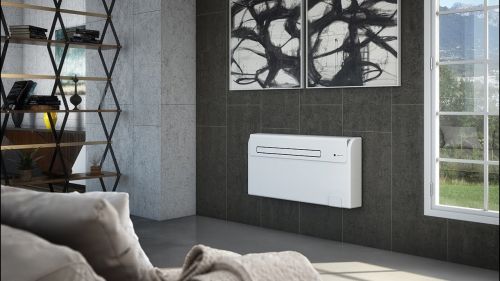
When you find yourself in the difficult position of deciding which air conditioner to choose there are some conditions that reduce the possibilities, forcing you to aim for more specific solutions, as in the case of air conditioner without an outdoor unit.
As is well known, an air conditioner is made up of two main elements: the indoor unit, or split unit, installed inside the home, office, or shop, and the outdoor unit, which represents the motor, fixed to the facade of the building.
Well, in some cases, it is not possible to attach the outdoor unit to the facade of the building, due to urban planning, architectural, historical constraints, or condominium regulations.
In these circumstances, there is no other solution. other than installing an air conditioner without an external unit.
Let's see together what it is, how it works, and what the pros and cons of this type of air conditioner are.
What is an air conditioner without an external unit?
As the name itself suggests, and as we have also explained in the previous lines, an air conditioner without an external unit consists of a device composed only of an external unit. internal split, therefore without the motor to install on the facade of the building.
Therefore, inside the room, not much changes compared to a model equipped with an external unit, because there is always a split unit, similar if not identical to the others, to be operated with the remote control to obtain cool or hot air.
But be careful, because there is a small detail that makes the difference between a traditional air conditioner and one without an external unit.
The latter, in fact, requires two holes to facilitate the passage of air from outside to inside and vice versa, an action generally performed by the external unit, a bit like what happens with portable air conditioners.
Therefore,to install it, you need to drill two holes in the perimeter wall. data-mce-fragment="1"> on which it is installed to allow heat exchange, which have a very minimal aesthetic impact (we're talking about 15-20 cm in diameter), so much so that they are permitted even in buildings where a traditional air conditioner cannot be installed.
Why install an air conditioner without an external unit
In the introduction, we explained that it is not always possible to install the air conditioner you want, because there are situations that make certain solutions mandatory, such as the data-mce-fragment="1"> air conditioner without an external unit.
This happens when, for example:
- there are condominium rules and constraints that prevent the installation of an external unit on the facade of the building, generally for reasons related to decorum and aesthetics;
- there are urban planning constraints and architectural, especially frequent in historic centers and areas of high historical/artistic value, which cannot be artificially damaged;
- when you live in a building of historical interest, on whose external walls it is not possible to install an air conditioner motor.
In these cases, the only solution to adopt is to install an air conditioner without an external unit.
Let's see together which These are the pros and cons of this option.
Pros and cons of air conditioners without an external unit
In the absence of more traditional alternatives, installing a device without an external unit is certainly a useful solution, but it presents some pros and some cons that cannot be ignore.
Pros:
- It's possible to install an air conditioner even in contexts where it's not possible to install an external unit;
- Even in the absence of constraints and limitations, you can avoid ruining the aesthetics of your home;
- maintenance is easier to perform, because it is all concentrated on a single element and can be done regardless of weather conditions;
- it does not produce annoying noises on the side of the building, which can cause inconvenience to neighbors.
Cons:
- On average, an air conditioner without an external unit costs a little more than traditional ones;
- they are slightly larger, precisely because they must also contain the motor, which, in traditional models, is housed in the external unit;
- it is not possible to choose the location for installing the internal split unit, because it can only be fixed to a perimeter wall due to the need to drill the two holes for heat exchange;
- they are noisier than traditional ones, due to the presence of the motor in the internal split unit.
In short, if you want to install an air conditioner at home even in those contexts where it is not possible you have to accept some disadvantages of this solution, Although some of these, such as noise, can be solved by purchasing a quieter model.
We recommend consulting the section dedicated to air conditioners without external units for sale on our e-commerce site, here.