


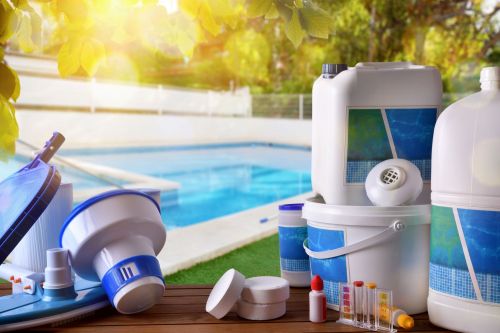
The heat has finally arrived, accompanied by good weather, allowing you tospend some free time in your home pool, provided you decide to do one essential thing:clean the pool.
Yes, because during the cold months we tend to neglect ordinary and extraordinary maintenance, and over timethe pool tends to accumulate dirt, algae, dust, bacteria and other pathogens, and certainly not You might consider refilling it and diving in without first proceeding with a deep cleaning.
Obviously, even after putting the pool into operation, you'll still need to clean it periodically to maintain perfect hygienic conditions.
Let's go step by step and see together how to clean your pool yourself and prepare for a satisfying summer swimming season.
Ordinary and extraordinary maintenance: how to proceed
A swimming pool is made up of various elements, all of which require routine and extraordinary maintenance and periodic intervention on your part.
To clean the pool properly, therefore, you will essentially need to address 3 factors:
- cleaning the walls and bottom of the Pool;
- Cleaning the filter;
- Cleaning the pool water.
Let's see how to proceed together.
1. Cleaning the walls and bottom of the pool
Whether it's an in-ground model orabove ground self-supporting, every pool has a bottom and four vertical walls, more or less high/deep, which require thorough cleaning.
Of all the steps, this is This is undoubtedly the one that requires the most elbow grease.
First, you'll need to vacuum and remove all the accumulated dirt, such as mud, leaves, plant debris, and algae, which accumulates on the bottom and walls.
If you want to optimize this process, we recommend using a pool vacuum cleaner such as the LAVOR vacuum cleaner for SWIMMY pools, with which you can easily remove all dirt with minimal effort.
This is a really economical and useful product, which will also allow you to perform daily and periodic cleaning after you start using it.
After removing the bulkier and coarser dirt, you'll need to equip yourself with rags and brushes and start cleaning the walls and floor until it shines. If the pool is empty, you can climb in and scrub more vigorously, also using specific detergents or, if necessary, a pressure washer.
2. Cleaning the Pool Filter
A swimming pool is, in effect, a huge basin containing water, which over time becomes increasingly opaque, cloudy, and stagnant because it is not replaced.
For this reason, it is essential to install a pump equipped with a filter, which sucks up the water, cleans it, and then reintroduces it back into the pool clear again.
Obviously, if the filter is dirty or clogged, this process will not produce a noteworthy result.
The filter cleaning methods Pool water cleaning varies depending on the model (cartridge or sand filter), but all require regular cleaning and maintenance.
3. Cleaning the Pool Water
The central element of a pool is undoubtedly the water, and the procedures illustrated in the first two points help keep it clean, but they are not enough.
In fact, in addition to removing accumulated dirt and keeping the filter functioning, it is necessary to pay attention to the clarity and purity of the water, achieving an optimal pH level.
How to do it? Let's find out.
Chlorine shock treatment
The first step consists of the so-called chlorine shock treatment, which is a very aggressive disinfection performed by adding higher doses of chlorine than those needed for periodic cleaning.
In this way, all bacteria, fungi, mold, and pathogens in general are killed, in order to make the pool water clear and sparkling.
This procedure must certainly be performed before making the pool suitable for swimming, but it must also be repeated periodically (about every 15 days), but never abuse, because an excessive amount of chlorine in the water can cause problems for the skin and eyes of those who go swimming.
For the chlorine shock treatment, use a specific product, called Dicloro, as indicated in the instructions, setting the filter to "Recirculation", and it is preferable to perform it after sunset.
Before diving into the pool, it is advisable to wait at least 24 hours.
To keep the water clean, you need to add chlorine in the right proportions, evaluating a product in powder or tablets.
Maintaining optimal pH
The pH of pool water is essential for the well-being of those who will be swimming, and can be achieved using specific products.
Before adjusting it, however, it is necessary to measure it, thanks to dedicated kits available in specialized stores.
If If the pH is too high, you can use acidic products such as hydrochloric acid, sulfuric acid, and sodium bisulfate. If the pH is too low, use sodium hydroxide and sodium bicarbonate.
The pH of the pool water must be between 7.4 and 7.6 on a scale of 0 to 14.
When the water becomes cloudy, algae can form, both on the surface and along the walls and bottom. To avoid this problem, there are specific algaecide products on the market, which should be used as directed on the package. If you want to enjoy your pool and swim safely, especially if you have small children in the family, it is essential to clean the pool properly and regularly. In fact, it is not enough to clean it once a year for the whole summer; you must do so periodically, taking care to keep the water, walls, bottom, and filter spotless.Add An algaecide
Conclusions