


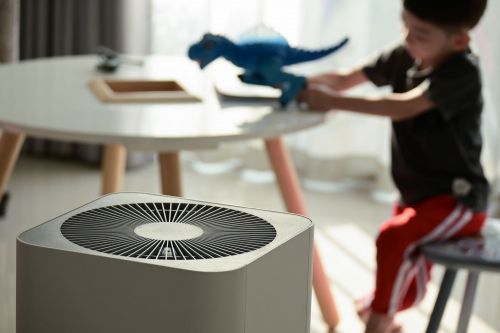
In recent years, we have witnessed a substantial growth in air purifier sales, particularly during the pandemic, which has clearly highlighted the role of indoor pollution as a threat to our health.
In fact, we spend the vast majority of our day indoors, exposing us to a large amount of pollutants and toxins, which data-mce-fragment="1">make air purifiers an extremely useful household appliance.
But does it really work? Are the air purifiers on the market today actually capable of sanitizing the environments in which we spend a good part of our day?
Let's dig deeper.
What are air purifiers and how do they work?
Let's start by saying that Air purifiers play the opposite role to other devices, such as humidifiers or essential oil diffusers, because unlike the latter, they do not introduce new particles into the air already present, but capture existing ones, removing them from the environment.
However, they do more than just filter these particles, which are pollutants that can damage the lung alveoli and cause various diseases.
In fact, air purifiers have the task of disinfecting these particles, an extremely useful function especially in environments where sanitization is essential, such as doctor's offices, clinics, restaurant kitchens, but also in homes where children or people with allergies and respiratory problems live.
Indoor air pollution
In the introduction, we referred to indoor air pollution, otherwise known as “indoor pollution”.
In fact, in industrialized countries, a majority of the population spends approximately 90% of its time in man-made, indoor environments, thus exposing itself to a large amount of potentially toxic substances.
But What is indoor pollution? According to the definition of the Italian Ministry of Health, indoor pollution is defined as:
"the modification of the normal composition or physical state of indoor atmospheric air, due to the presence of one or more substances in quantities and with characteristics such as to alter the normal environmental and health conditions of the air itself and such as to constitute a danger or a direct or indirect harm to human health."
Unlike outdoor pollution, whose harmful effects on human health and the main anthropogenic causes are well known, only in recent years has the need to deepen our knowledge of indoor pollution emerged, especially in the face of growing alarming scientific evidence on the health effects associated with This phenomenon.
This is why we've only been hearing about air purifiers for a few years now, because before that, the topic of indoor air pollution was little known, little studied, and little explored.
Are they really effective?
According to some studies conducted over the past few years, it would seem so: air purifiers really work.
As explained, these devices do not just filter particles present in the air of closed environments, but they also perform a disinfectant function, which makes the neutralization of harmful substances more effective. pollutants.
It is important to underline, however, that an air purifier alone is not capable of removing every particle present, mainly for two reasons.
The first is related to the product itself, because some devices are declared effective for some specific substances, but not for all of them. It is therefore advisable to check the product's technical data sheet very carefully to ensure it meets your needs.
The second is related to an aspect that we tend not to think about. Particles present in the air, in fact, do not always remain suspended, but sooner or later they settle on surfaces, especially fabrics in the home, and in this The air purifier can't do much.
Rather, you'll need to wash and disinfect these surfaces and fabrics.
That said, having an air purifier and turning it on periodically reduces the amount of particles in the air and, consequently, those that manage to settle on the soft and hard surfaces of the home.
If inserted within a more comprehensive strategy aimed at completely sanitizing the home, then the data tells us that air purifiers really work, and very effectively, too.
What particles are they effective against?
We explained that indoor pollution exposes us to toxic substances that damage our lungs. But What particles can air purifiers remove and disinfect?
Here are the main ones:
- Allergens;
- Mold;
- Smoke;
- Toxins emitted by cleaning products, personal care products, and more;
- toxins released by combustion, for example from kitchen gas burners, from the fireplace, from a pellet stove, from a wood-burning stove, and so on;
- pollutants coming from the outside environment, through windows or air conditioning systems. For this reason, it is recommended to proper cleaning and maintenance of air conditioner filters;
- bad odors.
Some models may be more effective against specific pollutants, as listed in the manual.
The advantages of air purifiers Air Purifiers
By removing particles from the air, air purifiers are an excellent device to have at home, especially in families with allergy sufferers or asthmatics.
In fact, thanks to their action, substances that can promote allergic reactions, coughs, and respiratory problems are filtered and disinfected, improving the quality of life of allergy or asthma sufferers.
Let's be clear: an air purifier is not a substitute for doctor-prescribed medications, but it is undoubtedly an excellent aid.
If you're looking for an air purifier for your home, we recommend our Daikin MC55W with Remote Control Included. Find out here here.